

How Much Is A 1963 Split Window Corvette Worth
The Chevrolet Corvette had America at its debut itself, even though the Corvette of and then and of now is way, style different from each other, in terms of safety, speed, and of grade, technology. Just this was America'south very ain sports machine and it was loved in ways big and small from the beginning.
And one of the coolest Vettes ever, in terms of styling and even rarity for that matter is the 1963 split-window model, the only one e'er made, unique to that year. While information technology was a Vette and a fast and sporty bulldoze, it was besides one with a very distinguishable feature, that split rear window. This is a car you lot'd adore if you lot weren't a Vette fan or even a car addict because merely the looks made it stand out.
It's a vintage, and add to that, it's a priceless rare vintage. So here'due south a scrap about the history of the 1963 carve up-window Corvette and how much it's worth today…
The 1963 Corvette Sting Ray Specs
The 1963 Corvette Sting Ray took the world by storm. Hidden headlights, a rather abrupt forepart, and that split rear window fabricated information technology i large striking. The v.three-liter V8 power manufactory fabricated 250-360 horses with a fuel-injection, taking this car to summit speeds of 120 -150 mph with ease. A 0-60 mph sprint was an active 5.eight seconds in the fastest trim.
Power brakes, power steering, and power windows were added options, every bit was ac, the outset-e'er offered in the Vette. Y'all could accept this car in a four-speed transmission transmission or even on a two-speed automated 1.
With all the bells and whistles, the C3 Corvette could be yours for $5,500, a rather princely sum for the time, but and then again, the Corvette was never one for the stingy-pursed. Sales jumped up, from most 14,500 sold in 1962, to 21,500 in 1963. The C3 was a runaway success, and out of these, it's the split-window models that were the near desirable back and so and the most expensive today.
The Separate Behind The Carve up Window
The divide window came from the vision of styling chief William L. "Bill" Mitchell, and his obsession with marine life. True to the stingray's name, the C3 Sting Ray has gentle peaking fenders, vents on the forepart fenders, and a "spine" that runs through the automobile, bisecting it into two. This very split in the back window was created to keep that bisecting stripe in continuity, and Mitchell stuck to his guns even though others at GM were non in favor of the design.
Why, because if you accept ever had the honor of sitting at the driver's wheel of this split-window Corvette, you'll encounter that visibility from that rear window is basically side by side to nothing. The auto was bought in droves and GM then proceeded to receive a barrage of complaints in return from the buyers, who said that they could see and predict nothing equally to what was on the road backside them. Major problems when backing up, or fifty-fifty driving on a high-traffic, high speed-road. This was the reason why in 1964, the split window was dropped like a hot potato.
In fact, even when this blueprint was presented by Mitchell, Zora Arkus-Duntov, the director of high-operation GM vehicles found it to be a problem and was against information technology. But such was Mitchell'southward bullheadedness that in 1963, his say was done, despite raging red-faced fights between him and Duntov.
Later, it was constitute that this split-window was also very labor-intensive and took twice as long on the assembly line every bit opposed to a normal single-slice rear window. So finally, Duntov's practicality won over Mitchell'due south creativity and by 1964, the Corvette'due south rear window was ane whole again.
Of form, if you lot had to credit (or even blame) someone at GM for the carve up-window blueprint, another stalwart was Japanese-American designer Larry Shinoda, who gave Mitchell'due south vision and sketches an actual class.
So think of this split-window Corvette as an international melting pot: of the vision of an American stylist, the real-life creation from a Japanese designer, and the grudging acceptance from a Belgian engineer. Mitchell's ultimate achievement through this design was to be able to convey motion at residuum, the power to look like it was racing off, even though information technology was parked.
The Value & Worth Of The Dissever-Window Corvette, Today
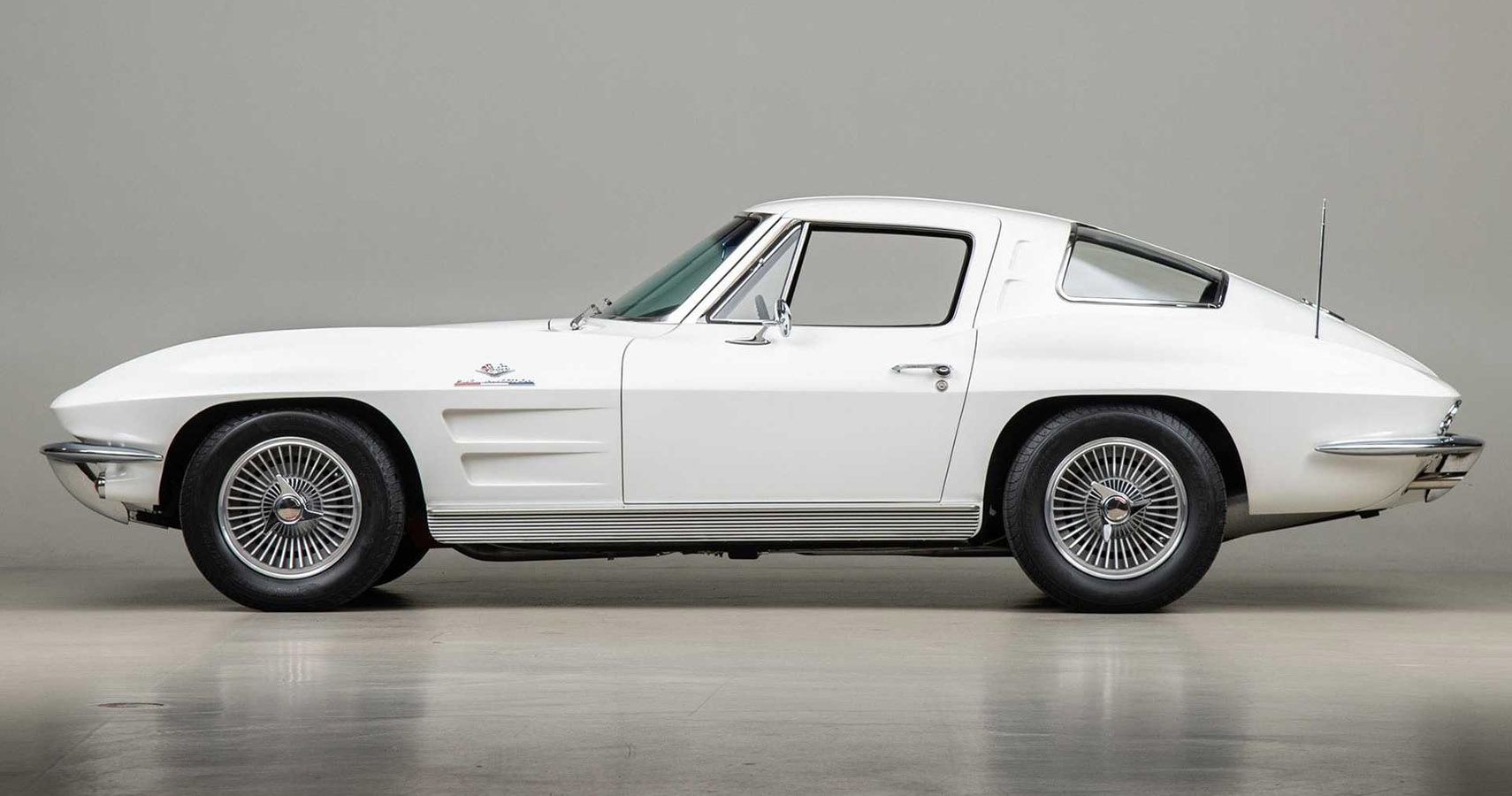
At the time, the top trim of this split-window Vette was above $v,000. Information technology was gorgeous and despite the impracticality of the vision-blocking split-window, information technology sold similar hotcakes. The carmine on pinnacle was the air-con, making this one of the most important vintage Corvettes of its decade.
According to Hagerty, the standard value of a split-window Corvette in a well-worn condition, with work needed to bandbox it up can still bear on $50,000. A mint condition vehicle can easily fetch three-4 times that amount and attain $200,000.
Rare, cute, and expensive, this is non a collectible you should let rust away in a barn. This can be quite the investment and for ones who already own one from the '60s, a cracking nest egg.
Sources: LSXMag, Hagerty
Source: https://www.hotcars.com/split-window-corvette-how-much-worth-today/
Posted by: griffinlonlied1957.blogspot.com
0 Response to "How Much Is A 1963 Split Window Corvette Worth"
Post a Comment