

How To Clean Ls1 Trans Am Fuel System
Table of Contents
- Air fuel ratio definition
- Air fuel ratio formula
- Air fuel ratio for different fuels
- How stoichiometric air fuel ratio is calculated
- Lambda air fuel ratio
- Air fuel ratio and engine performance
- Air fuel ratio calculator
- Impact of air fuel ratio on engine emissions
- Lambda closed-loop combustion command
Air fuel ratio definition
Thermal engines employ fuel and oxygen (from air) to produce energy through combustion. To guarantee the combustion process, sure quantities of fuel and air need to be supplied in the combustion chamber. A complete combustion takes identify when all the fuel is burned, in the exhaust gas there will be no quantities of unburnt fuel.
Air fuel ratio is defined as the ratio of air and fuel of a mixture prepared for combustion. For instance, if we take a mixture of methane and air which has the air fuel ratio of 17.five, information technology ways that in the mixture nosotros have 17.5 kg of air and one kg of methane.
The ideal (theoretical) air fuel ratio, for a consummate combustion, is chosen stoichiometric air fuel ratio. For a gasoline (petrol) engine, the stoichiometric air fuel ratio is around 14.7:1. This means that, in lodge to fire completely 1 kg of fuel, we demand xiv.7 kg of air. The combustion is possible even is the AFR is different than stoichiometric. For the combustion process to take identify in a gasoline engine, the minimum AFR is around 6:1 and the maximum can go up to 20:one.
When the air fuel ratio is higher than the stoichiometric ratio, the air fuel mixture is called lean. When the air fuel ratio is lower than the stoichiometric ratio, the air fuel mixture is chosen rich. For example, for a gasoline engine, an AFR of 16.5:1 is lean and 13.7:1 is rich.
Go back
Air fuel ratio formula
In the context of internal combustion engines, air fuel ratio (AF or AFR) is divers as the ratio betwixt the mass of air ma and mass fuel mf , used by the engine when running:
\[\bbox[#FFFF9D]{AFR = \frac{m_a}{m_f}} \tag{one}\]
The inverse ratio is called fuel-air ratio (FA or FAR) and it's calculated as:
\[FAR = \frac{m_f}{m_a} = \frac{one}{AFR} \tag{1}\]
Go dorsum
Air fuel ratio for different fuels
In the table below we can see the stoichiometric air fuel ratio for several fossil fuels.
| Fuel | Chemical formula | AFR |
| Methanol | CHthreeOH | 6.47:one |
| Ethanol | C2HvOH | 9:1 |
| Butanol | CivHixOH | xi.2:1 |
| Diesel | C12H23 | 14.five:i |
| Gasoline | C8H18 | fourteen.7:1 |
| Propane | C3Height | xv.67:1 |
| Marsh gas | CH4 | 17.xix:ane |
| Hydrogen | Hii | 34.3:one |
Source: wikipedia.org
For example, in order to fire completely ane kg of ethanol, we demand 9 kg of air and to burn 1 kg of diesel fuel, we need 14.5 kg of air.
Spark ignition (SI) engines usually run on gasoline (petrol) fuel. The AFR of the SI engines varies within the range 12:1 (rich) to twenty:1 (lean), depending on the operating status of the engine (temperature, speed, load, etc.). Modern internal combustion engines operate equally much as possible around the stoichiometric AFR (mainly for gas after-treatment reasons). In the table below you tin can see an example of a SI engine AFR, function of engine speed and torque.
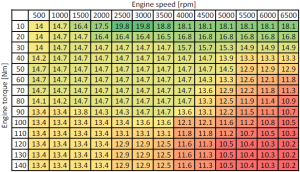
Prototype: Example of air fuel ratio (AFR) function of engine speed and torque
Compression ignition (CI) engines commonly run on diesel fuel fuel. Due to the nature of the combustion process, CI engines always run on lean mixtures, with AFR between xviii:1 and seventy:1. The main difference, compared with SI engines, is that CI engines run on stratified (non homogeneous) air fuel mixtures, while SI run on homogeneous mixtures (in instance of port-injection engines).
The tabular array in a higher place is entered in a Scilab script and a profile plot is generated.
EngSpd_rpm_X = [500 1000 1500 2000 2500 3000 3500 4000 4500 5000 5500 6000 6500]; EngTq_Nm_Y = [10;xx;30;40;50;60;lxx;80;xc;100;110;120;130;140]; EngAFR_rat_Z = [xiv 14.7 16.four 17.5 19.viii 19.eight 18.8 18.1 xviii.1 eighteen.1 18.ane xviii.1 18.ane; xiv 14.7 14.7 sixteen.4 16.iv sixteen.4 16.5 16.viii 16.eight sixteen.8 sixteen.8 16.viii sixteen.eight; xiv xiv.seven 14.7 14.7 fourteen.seven 14.7 xiv.7 15.7 15.7 15.3 14.nine 14.9 xiv.9; fourteen.2 14.vii 14.7 14.vii 14.seven 14.7 xiv.7 14.vii 14.7 13.ix xiii.three xiii.3 13.3; xiv.seven 14.7 14.7 fourteen.vii 14.7 14.7 xiv.vii 14.vii 14.7 14.v 12.ix 12.9 12.9; xiv.7 14.7 fourteen.vii 14.7 fourteen.vii 14.7 xiv.7 fourteen.7 14.3 13.three 12.6 12.1 11.8; 14.7 xiv.7 fourteen.vii 14.7 14.7 xiv.7 xiv.7 14.vii thirteen.half dozen 12.9 12.two eleven.8 11.3; 14.1 fourteen.2 14.7 14.7 14.7 14.7 14.7 xiv.7 13.3 12.5 11.ix 11.iv 10.9; 13.4 13.iv xiii.8 14.3 14.3 fourteen.vii 14.7 thirteen.vi 13.one 12.2 eleven.five 11.1 10.7; 13.4 13.4 13.4 13.4 xiii.4 13.6 thirteen.6 12.1 12.1 11.6 eleven.two 10.8 10.5; 13.iv 13.4 13.4 13.4 xiii.one 13.1 13.1 eleven.viii 11.8 xi.2 10.7 10.5 10.3; 13.iv xiii.4 13.iv 13.4 12.nine 12.9 12.5 11.half-dozen 11.3 ten.v 10.4 10.3 10.2; thirteen.four xiii.iv thirteen.iv 13.iv 12.9 12.9 12.five xi.6 11.3 x.five 10.4 10.3 10.2; xiii.iv thirteen.4 13.four thirteen.4 12.ix 12.9 12.5 11.6 eleven.iii ten.v 10.4 x.3 ten.2]; contour(EngSpd_rpm_X,EngTq_Nm_Y,EngAFR_rat_Z',30) xgrid() xlabel('Engine speed [rpm]') ylabel('Engine torque [Nm]') title('10-engineer.org') Running the Scilab instructions above will generate the following contour plot:

Image: Air fuel contour plot with Scilab
Go back
How stoichiometric air fuel ratio is calculated
In order to understand how the stoichiometric air fuel ratio is calculated, we need to look at the combustion process of the fuel. Combustion is basically a chemical reaction (called oxidation) in which a fuel is mixed with oxygen and produces carbon dioxide (CO2), water (HtwoO) and energy (heat). Take into account that, in order for the oxidation reaction to occur we demand an activation energy (spark or high temperature). Likewise, the net reaction is highly exothermic (with heat release).
\[\text{Fuel}+\text{Oxygen}\xrightarrow[high \text{ } temperature \text{ (CI)}]{spark \text{ (SI)}} \text{Carbon dioxide} + \text{Water} + \text{Energy}\]
Example 1. For a better understanding, let's wait at the oxidation reaction of marsh gas. This is a pretty common chemical reaction, since methyl hydride is the primary component of natural gas (in proportion of around 94 %).
Pace 1. Write the chemical reaction (oxidation)
\[CH_4 + O_2 \rightarrow CO_2 + H_2O\]
Step ii. Balance the equation
\[CH_4 + {\color{Cerise} 2} \cdot O_2 \rightarrow CO_2 +{\colour{Red} ii} \cdot H_2O\]
Pace 3. Write downward the standard diminutive weight for each atom
\[ \brainstorm{dissever}
\text{Hydrogen} &= one.008 \text{ amu}\\
\text{Carbon} &= 12.011 \text{ amu}\\
\text{Oxygen} &= fifteen.999 \text{ amu}
\end{divide} \]
Pace iv. Summate the mass of fuel, which is i mol of marsh gas, made upward from 1 atom of carbon and 4 atoms of hydrogen.
\[m_f =12.011 + iv \cdot 1.008 = 16.043 \text{ g}\]
Stride 5. Calculate the mass of oxygen, which consists of 2 moles, each mol fabricated upwards from 2 atoms of oxygen.
\[m_o =2 \cdot xv.999 \cdot 2= 63.996 \text{ m}\]
Footstep 6. Summate the necessary mass of air which contains the calculated mass of oxygen, taking into business relationship that air contains around 21 % oxygen.
\[m_a = \frac{100}{21} \cdot m_o=\frac{100}{21} \cdot 63.996 = 304.743 \text{ g}\]
Step vii. Calculate the air fuel ratio using equation (1)
\[AFR = \frac{m_a}{m_f} = \frac{304.743}{xvi.043} = 18.995 \]
The calculated AFR for methane is not exactly as specified in the literature. The difference might come from the fact that, in our case, we made several assumptions (air contains only 21 % oxygen, the products of the combustion are only carbon dioxide and water).
Case ii. The same method tin be applied for the combustion of gasoline. Considering that gasoline is made upwardly from iso-octane (CviiiH18), calculate the stoichiometric air fuel ratio for gasoline.
Step 1. Write the chemical reaction (oxidation)
\[C_{8}H_{eighteen} + O_2 \rightarrow CO_2 + H_2O\]
Pace 2. Balance the equation
\[C_{viii}H_{18} + {\colour{Red} {12.v}} \cdot O_2 \rightarrow {\colour{Cherry} 8} \cdot CO_2 +{\color{Red} 9} \cdot H_2O\]
Step iii. Write down the standard diminutive weight for each atom
\[ \begin{split}
\text{Hydrogen} &= 1.008 \text{ amu}\\
\text{Carbon} &= 12.011 \text{ amu}\\
\text{Oxygen} &= xv.999 \text{ amu}
\end{carve up} \]
Footstep four. Calculate the mass of fuel, which is 1 mol of iso-octane, made up from 8 atoms of carbon and eighteen atoms of hydrogen.
\[m_f =viii \cdot 12.011 + 18 \cdot 1.008 = 114.232 \text{ g}\]
Step five. Calculate the mass of oxygen, which consists of 12.v moles, each mol made up from two atoms of oxygen.
\[m_o =12.5 \cdot fifteen.999 \cdot 2= 399.975 \text{ g}\]
Step half dozen. Calculate the necessary mass of air which contains the calculated mass of oxygen, taking into account that air contains around 21 % oxygen.
\[m_a = \frac{100}{21} \cdot m_o=\frac{100}{21} \cdot 399.975 = 1904.643 \text{ g}\]
Step 7. Calculate the air fuel ratio using equation (i)
\[AFR = \frac{m_a}{m_f} = \frac{1904.643}{114.232} = 16.673 \]
Again, the calculated stoichiometric air fuel ratio for gasoline is slightly different that the one provided in literature. Thus, the result is adequate since we made a lot of assumptions (gasoline contains merely iso-octane, air contains just oxygen in proportion of 21 %, the only products of combustion are carbon dioxide and water, the combustion is ideal).
Go back
Lambda air fuel ratio
We have seen what is and how to calculate the stoichiometric (ideal) air fuel ratio. In reality, internal combustion engines exercise non work exactly with ideal AFR, but with values close to it. Therefore we'll accept an ideal and a actual air fuel AFR ratio. The ratio between the actual air fuel ratio (AFRactual) and the ideal/stoichiometric air fuel ratio (AFRplatonic) is called equivalence air fuel ratio or lambda (λ).
\[\bbox[#FFFF9D]{\lambda = \frac{AFR_{bodily}}{AFR_{ideal}}} \tag{3}\]
For instance, the ideal air fuel ratio for a gasoline (petrol) engine is 14.7:1. If the bodily/real AFR is 13.5, the equivalence gene lambda volition be:
\[\lambda = \frac{xiii.5}{14.7} = 0.92\]
Depending on the value of lambda, the engine is told to work with lean, stoichiometric or rich air fuel mixture.
| Equivalence factor | Air fuel mixture type | Description |
| λ < 1.00 | Rich | There is not enough air to burn completely the corporeality of fuel; after combustion there is unburnt fuel in the exhaust gases |
| λ = 1.00 | Stoichiometric (ideal) | The mass of air is verbal for a complete combustion of the fuel; after combustion there is no excess oxygen in the exhaust and no unburnt fuel |
| λ > 1.00 | Lean | There is more oxygen than required to burn completely the amount of fuel; later on combustion there is backlog oxygen in the exhaust gases |
Depending on the type of fuel (gasoline or diesel) and the type of injection (direct or indirect), an internal combustion engine can function with lean, stoichiometric or rich air fuel mixtures.

Image: Ecoboost 3-cylinder direct injection gasoline engine (lambda map)
Credit: Ford
For instance, the Ford Ecoboost 3-cylinder engine runs with stoichiometric air fuel ratio for idle to medium engine speed and complete load range, and with rich air fuel mixture at loftier speed and load. The reason for which it runs with rich mixture at high engine speed and load is engine cooling. The additional fuel (which will remain unburnt) is injected to absorb rut (through evaporation), reducing this way the temperature in the combustion chamber.

Prototype: Diesel fuel engine (lambda map)
Credit: wtz.de
A compression ignition (diesel) engine runs all the time with lean air fuel mixture, the value of the equivalence factor (λ) depending on the engine'south operating point (speed and torque). The reason for this is the working principle of a diesel engine: decision-making load not through air mass (which is always in backlog) but through fuel mass (injection fourth dimension).
Remember that a stoichiometric equivalence factor (λ = i.00) means an air fuel ratio of 14.7:1 for gasoline engines and 14.5:1 for diesel engines.
Go back
Air fuel ratio and engine performance
The engine functioning in terms of power and fuel consumption is highly dependent on the air fuel ratio. For a gasoline engine, the lowest fuel consumption is obtained at lean AFR. The main reason is that there is enough oxygen available to burn down completely all the fuel which translates in mechanical work. On the other hand, the maximum power is obtained with rich air fuel mixtures. Every bit explained before, putting more than fuel in the cylinder at high engine load and speed, cools downward the combustion bedchamber (through fuel evaporation and heat absorption) which allows the engine to produce maximum engine torque thus maximum power.

Image: Engine power and fuel consumption part of air fuel ratio (lambda)
In the effigy to a higher place nosotros can see that we tin not get the maximum ability of the engine and the lowest fuel consumption with the same air fuel ratio. The lowest fuel consumption (best fuel economy) is obtained with lean air fuel mixtures, with an AFR of 15.4:i and an equivalence factor (λ) of one.05. The maximum engine ability is produced with rich air fuel mixtures, with an AFR of 12.6:1 and an equivalence factor (λ) of 0.86. With a stoichiometric air fuel mixture (λ = 1), in that location is a compromise between maximum engine ability and minimum fuel consumption.
Compression ignition (diesel) engines always run on lean air fuel mixtures (λ > i.00). Most of the modernistic diesel fuel engines run with λ betwixt 1.65 and i.10. The maximum efficiency (lowest fuel consumption) is obtained around λ = 1.65. Increasing the fuel amount above this value (going towards 1.x) will produce more soot (unburnt fuel particles).
There is an interesting study performed by R. Douglas on two-stroke bicycle engines. In his doctoral thesis "Closed Cycle Studies of a Two-Stroke Bicycle Engine", R. Douglas comes with a mathematical expression of the combustion efficiency (ηλ) function of equivalence factor (λ).
For spark ignition (gasoline engine) with an equivalence factor between 0.lxxx and 1.20, the combustion efficiency is:
\[\eta_{\lambda}=-1.6082+four.6509 \cdot \lambda – two.0746 \cdot \lambda^2 \tag{4}\]
For compression ignition (diesel engine) with an equivalence factor between 1.00 and 2.00, the combustion efficiency is:
\[\eta_{\lambda}=-4.eighteen+8.87 \cdot \lambda – 5.14 \cdot \lambda^two + \lambda^iii \tag{5}\]
For diesel fuel engines, if the equivalence gene goes above two.00, the combustion efficiency is maximum (1.00 or 100 %).
We can use a Scilab script to plot the variation of the combustion efficiency function of the equivalence gene.
lmbd_g = [0.eighty:0.01:1.20]; lmbd_d = [one.00:0.01:2.00]; eff_lmbd_g = -one.6082+4.6509*lmbd_g-2.0746*lmbd_g.^ii; eff_lmbd_d = -4.18+8.87*lmbd_d-5.14*lmbd_d.^2+lmbd_d.^3; plot(lmbd_g,eff_lmbd_g,'b','LineWidth',2) hold plot(lmbd_d,eff_lmbd_d,'r','LineWidth',2) xgrid() xlabel('$\lambda \text{ [-]}$') ylabel('$\eta_{\lambda} \text{ [-]}$') title('x-engineer.org') legend('gasoline','diesel fuel',four) Running the Scilab instructions higher up outputs the post-obit graphical window.

Image: Combustion efficiency function of equivalence cistron
As you lot tin can run across, the compression ignition (diesel) engine, at stoichiometric air fuel ratio has a very low combustion efficiency. The best combustion efficiency is obtained at λ = ii.00 for diesel and λ = ane.12 for spark ignition (gasoline) engines.
Go back
Air fuel ratio reckoner
| ma [yard] | Fuel blazon | λ [-] |
| mf [g] | ηλ [%] |
Observation: The combustion efficiency is only calculated for diesel fuel and gasoline (petrol) fuel, using equations (iv) and (five). For the other fuels, the combustion efficiency calculation is not available (NA).
Become back
Impact of air fuel ratio on engine emissions
Internal combustion engine exhaust gas emissions depend heavily on the air fuel ratio (equivalence cistron). The master exhaust gas emissions in Water ice are summarised in the table below.
| Exhaust gas emission | Clarification |
| CO | carbon monoxide |
| HC | hydrocarbon |
| NOx | nitrogen oxides |
| Soot | unburnt fuel particles |
For a gasoline engine, CO, HC and NOx frazzle gas emissions are heavily influenced past air fuel ratio. CO and HC are mainly produced with rich air fuel mixture, while NOx with lean mixtures. And then, there in no fixed air fuel mixture for which we tin obtain the minimum for all frazzle emissions.

Image: Gasoline engine goad efficiency function of air fuel ratio
A three way catalyst (TWC), used for gasoline engines, has the highest efficiency when the engine operates in a narrow band around stoichiometric air fuel ratio. The TWC converts between l … xc % of hydrocarbons and 90 … 99 % of carbon monoxide and nitrogen oxides, when the engine runs with λ = ane.00.
Go back
Lambda closed-loop combustion command
In club to run into the frazzle gas emissions regulations, it is critical for internal combustion engines (peculiarly gasoline) to have an accurate control of the air fuel ratio. Therefore, all of the modern internal combustion engines have airtight-loop control for air fuel ratio (lambda).
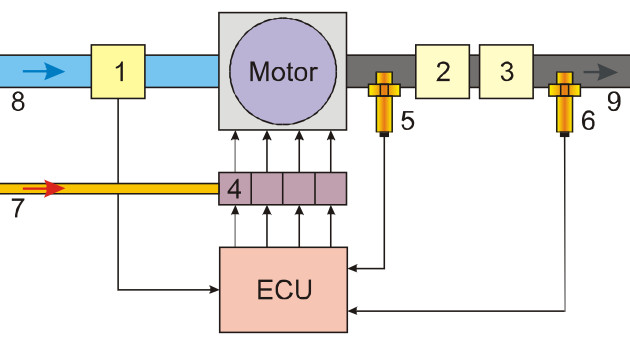
Image: Internal combustion engine closed-loop lambda control (gasoline engines)
- air mass flow sensor
- primary catalyst
- secondary catalyst
- fuel injector
- upstream lambda (oxygen) sensor
- downstream lambda (oxygen) sensor
- fuel supply circuit
- intake manifold
- exhaust manifold
The critical component for the system to work is the lambda (oxygen) sensor. This sensor measures the level of oxygen molecules in the exhaust gas and sends the information to the engine electronic control unit (ECU). Based on the value of the oxygen sensor reading, the gasoline engine ECU will adjusts the level of fuel mass in club to continue the air fuel ratio around the stoichiometric level (λ = one.00).
For example (gasoline engines), if the level of oxygen molecules is above the threshold for stoichiometric level (therefore we have a lean mixture), at the next injection bike, the injected fuel amount volition be increased in lodge to make use of the excess air. Bear in mind that the engine will ever transition from lean mixture to rich mixture betwixt injection cycles, which volition requite an "average" of stoichiometric air fuel mixtures/ratio.
For diesel engines, since it always runs on lean air fuel ratio, lambda control is performed in a unlike manner. The end goal beingness still the same, control of the exhaust gas emissions.
For whatever questions or observations regarding this tutorial delight utilize the comment class beneath.
Don't forget to Similar, Share and Subscribe!

Source: https://x-engineer.org/air-fuel-ratio/
Posted by: griffinlonlied1957.blogspot.com
0 Response to "How To Clean Ls1 Trans Am Fuel System"
Post a Comment